Choosing a weight-loss program is about more than the number on the scale. The programs below take very different approaches to food, structure, coaching, cost and long-term maintenance.
Jenny Craig and Nutrisystem are primarily prepared-food and meal-delivery programs, although both now offer different levels of flexibility in how meals and foods are selected. Weight Watchers uses a Points-based behavioral approach that gives members more control over the foods they choose while providing tools and support for weight management. Ideal Protein uses a more structured, coach-guided protocol with defined Weight Loss, Stabilization, and Maintenance phases.
In this comparison, we’ll look at how Jenny Craig, Nutrisystem, Weight Watchers, and Ideal Protein differ in their program structure, food approach, coaching and support, cost, flexibility, potential benefits and drawbacks, and what happens after the active weight-loss phase. The goal is not to declare one program universally “best,” but to help you understand the differences so you can determine which approach may fit your preferences, needs, and long-term goals.
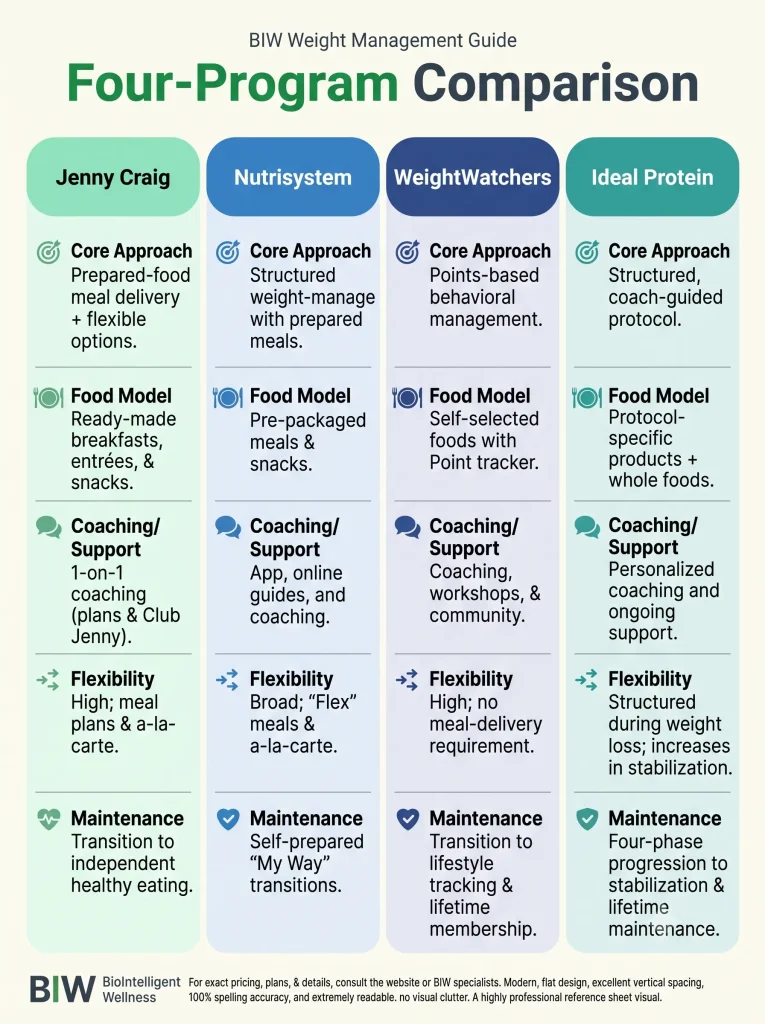
At-a-Glance Comparison
| Program | Core approach | Food model | Coaching / support |
Flexibility | Current public pricing example* |
|---|---|---|---|---|---|
| Jenny Craig | Prepared-food meal delivery + flexible food options | Ready-made breakfasts, entrées, snacks and other menu items delivered to the home | 1-on-1 coaching is available with current plans and Club Jenny | High flexibility through meal plans plus Club Jenny / a-la-carte options | Jenny Craig lists a $329.99 Jenny Craig Program; Breakfasts & Entrees plans at $169.99; Club Jenny $12.99/month |
| Nutrisystem | Structured weight-management program with prepared meals + flexible options | Ready-made meals and snacks; current plans vary in meal coverage and food configuration | 1-on-1 coaching, app and guides are part of current program options | Broader than the old fixed-box model; structured, flexible and a-la-carte options | Public 2026 listings show starting prices around $9.99/day; higher tiers/configurations cost more |
| WeightWatchers | Points-based behavioral weight-management program | Members select their own foods using Points, ZeroPoint foods and tracking tools | Coaching/support and community; Med+ adds clinical care for eligible members | High; no traditional full meal-delivery requirement | Core starts at $12/month; Core+ at $22/month; Med+ $25 first month then $74/month; meds separate |
| Ideal Protein | Structured, coach-guided protocol | Protocol-specific products + whole-food guidance across phases | Personalized coaching and ongoing support | More structured during active weight loss; flexibility increases through Stabilization/Maintenance | Ideal Protein says about $17/day average in North America for food + supplements; local fees vary. Ideal Protein+ lists $499/month or $279 every 2 weeks for its subscription model |
*Pricing is a snapshot, not a permanent quote. Promotions, plan configuration, shipment frequency, geographic availability and optional services can change.
Which Weight-Loss Program Is Best for You?
There is no single weight-loss program that is automatically best for every one. A better question is: Which approach fits your food preferences, desired level of structure, budget, need for coaching, willingness to prepare meals and long-term maintenance needs?
- If you want prepared food delivered to your home, Jenny Craig and Nutrisystem are the closest match.
- If you want to choose your own foods and prefer a tracking-based approach, WeightWatchers offers more day-to-day flexibility.
- If you prefer a more structured protocol with defined phases and coach guidance, Ideal Protein is a different type of approach.
- If maintenance support is especially important to you, look beyond the initial weight-loss phase and ask what support, food access or coaching remains available after you reach your goal.
If you are considering Ideal Protein and want help understanding whether its structure fits your goals, Bio Intelligent Wellness offers a free consultation with an Ideal Protein coach. A consultation can help you understand the protocol, the expected commitment and whether it is appropriate for your individual situation.
What Has Changed With These Weight-Loss Programs?
Older articles about these programs can be misleading because the brands and business models have changed.
Jenny Craig: From Brick-and-Mortar Centers to Direct-to-Consumer
Jenny Craig is currently operating as a direct-to-consumer/e-commerce brand. The original U.S. brick-and-mortar operation closed in 2023. Wellful acquired the Jenny Craig brand in 2023 and relaunched it as a home-delivery business.
Today, Jenny Craig offers meal-delivery plans, a-la-carte food options through Club Jenny, an app and coaching. Current Jenny Craig materials describe home delivery and remote coaching rather than the network of U.S. retail centers described in many older articles.
This distinction matters when reading older Jenny Craig reviews: evidence, pricing and customer experiences from the pre-2023 company should not automatically be treated as descriptions of today’s business.
Nutrisystem: More Than the Old 28-Day Box
Nutrisystem still offers structured meal-delivery programs, but the current model is broader than the older descriptions found in many comparison articles.
Current Nutrisystem options include structured weight-loss programs, meal-delivery plans with different food configurations, flexible ‘Your Way’ options and a-la-carte food purchasing. Current program pages also emphasize an app, guides, personalized meal plans and 1-on-1 coaching.
The practical takeaway is that the old description ‘Nutrisystem is simply a 28-day package of packaged meals’ is incomplete. The current service gives customers more ways to combine prepared foods, snacks and flexible meal choices.
Weight Watchers: Points Plus Digital Tools, Coaching and Medications
Weight Watchers continues to use its Points-based approach, but its current offering is broader than the traditional meetings-based Weight Watchers model.
Current membership options include Core and Core+, while Med+ combines Weight Watchers support with clinical care for eligible members seeking prescription weight-management medications. The current Points program also includes Zero Point foods, recipe resources, activity integration and digital tracking tools.
This means older descriptions that reduce Weight Watchers to weekly meetings or simple calorie/points counting are incomplete.
Ideal Protein: A Structured Three-Phase Protocol
Ideal Protein remains the most structurally different option in this comparison.
The current Ideal Protein protocol describes three phases: Weight Loss, Stabilization and Maintenance. Ideal Protein’s current materials also describe a standard ketosis-based protocol, a Low Carb Flex alternative and a mandatory supplement regimen for Phase 1.
Ideal Protein also now offers a newer direct subscription model, Ideal Protein+, with food and coaching delivered to customers. Local clinic pricing and consultation fees can differ, so users should distinguish the newer subscription from the pricing of an individual clinic.
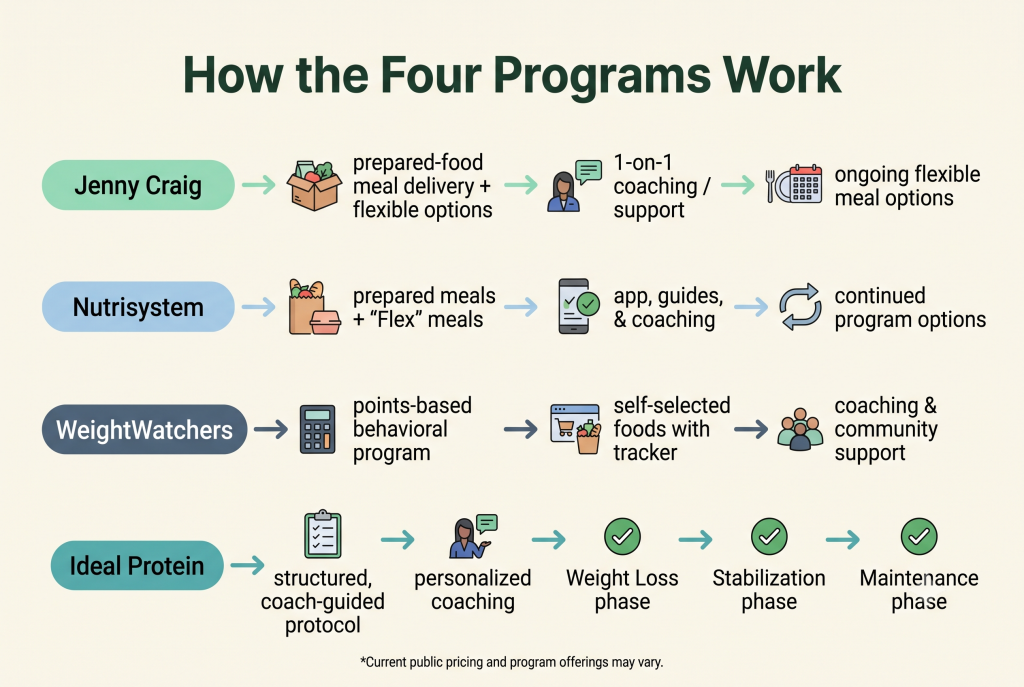
How Each Weight-Loss Program Works?
Jenny Craig
Jenny Craig’s current model is centered on prepared food delivered to the customer. Its current program provides breakfast, lunch, dinner and snacks, while other options allow customers to purchase selected meals and snacks through Club Jenny.
Coaching is available with current Jenny Craig plans and Club Jenny. This makes the current program more than a meal-delivery service: customers can combine food structure with remote coaching and digital resources.
Nutrisystem
Nutrisystem provides ready-to-eat meals and snacks designed to reduce the amount of planning and preparation required. Current options include structured weight-loss programs and flexible meal plans.
Nutrisystem also provides app-based tools, guides, personalized meal plans and 1-on-1 coaching. Customers may still need to purchase or prepare some grocery foods depending on the plan and the meals they choose.
Weight Watchers
Weight Watchers is primarily a behavioral and tracking program rather than a traditional meal-delivery program.
Members receive a Points budget and a Zero Point food list designed around their individual profile. They can choose their own foods and use the app to track meals and activity. Current plans also include coaching/support, and Med+ adds clinical services and access to prescription weight-management treatment for eligible members.
Ideal Protein
Ideal Protein is more structured during the active weight-loss phase. Its current protocol uses specific food categories, protocol products, whole-food guidance and coaching, then moves participants through Stabilization and Maintenance.
The purpose of this structure is not simply to provide a list of low-calorie foods. It is designed as a phased program in which food choices and coaching change as the participant progresses.
Jenny Craig vs. Nutrisystem
Both programs make weight loss easier by taking some of the day-to-day food decisions out of the process, but they are not identical.
Food and Meal Structure
Jenny Craig currently offers prepared breakfasts, entrées, snacks, desserts and other menu items, with options for both structured plans and more flexible a-la-carte ordering.
Nutrisystem also centers on prepared foods, but its current offering includes several plan configurations and flexible options. Depending on the plan, customers may combine Nutrisystem foods with grocery foods or choose from different amounts of meal coverage.
The biggest practical similarity is convenience: both can reduce the amount of cooking and meal planning required.
Coaching and Support
Jenny Craig currently provides access to 1-on-1 coaching with its plans and Club Jenny.
Nutrisystem’s current program materials also emphasize 1-on-1 coaching, personalized meal plans, an app and guides.
If personal support is important, compare not just whether coaching exists, but how often you can use it, how it is delivered and whether it is included in the price you are considering.
Cost: Jenny Craig vs. Nutrisystem
Jenny Craig’s current website lists examples including a Jenny Craig Program at $329.99 and Breakfasts & Entrees plans at $169.99. Club Jenny is currently listed at $12.99/month. Exact costs depend on the plan, shipment configuration and promotions.
Nutrisystem’s current pricing also varies by plan. Public 2026 pricing listings show starting prices around $9.99/day before discounts, while higher tiers and configurations cost more. The official Nutrisystem site currently offers multiple structured and flexible plan types rather than one universal monthly price.
For a fair comparison, compare the same amount of food and support rather than comparing the cheapest advertised entry price of one program with a premium package from another.
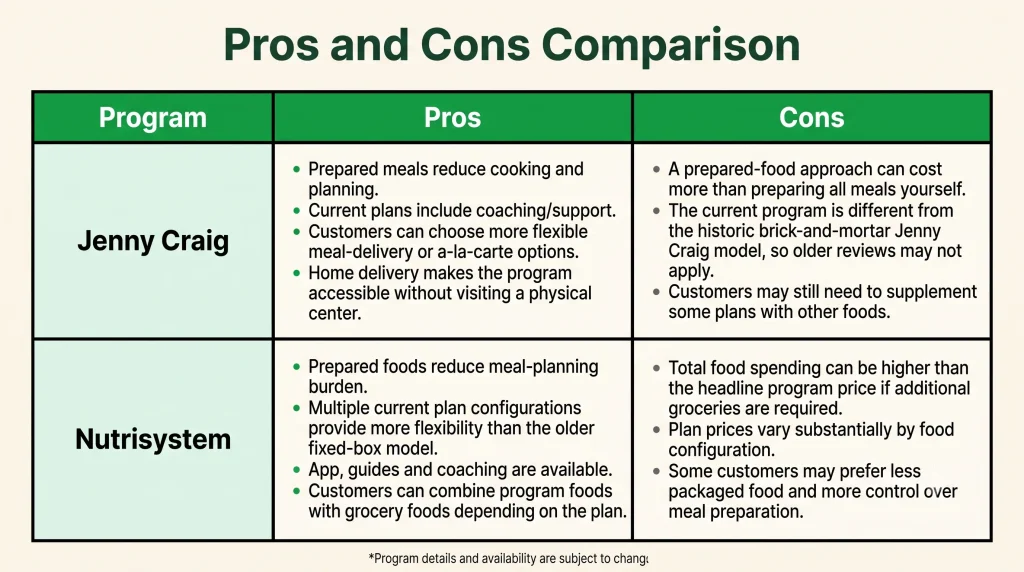
Pros and Cons
Which Is Better: Jenny Craig or Nutrisystem?
Neither is universally better.
Jenny Craig may appeal to someone who wants prepared meals plus coaching and the option to use a broader a-la-carte menu.
Nutrisystem may appeal to someone who wants structured prepared meals but also wants multiple plan configurations and flexible meal options.
The best choice depends on how much food you want delivered, how much cooking you are willing to do, how much coaching you need and what the complete monthly cost will be for your specific plan.
Nutrisystem vs. WeightWatchers
These programs are built around very different food experiences.
Food and Meal Preparation
Nutrisystem reduces meal-preparation decisions by supplying prepared foods. Depending on the plan, you may still prepare or purchase grocery foods.
WeightWatchers gives you much more control over what you eat. You choose the foods and use the Points system to guide portions and food choices.
This creates a straightforward trade-off:
- More prepared food = less daily planning, but less control over every meal.
- More self-selected food = more flexibility, but more responsibility for shopping, preparation and tracking.
Coaching and Support
Nutrisystem offers coaching, an app and guides with its current program options.
WeightWatchers offers digital tools and coaching/support, with Core, Core+ and Med+ providing different levels of service.
Cost: Nutrisystem vs. WeightWatchers
Current WeightWatchers pricing is comparatively simple to describe by membership tier: Core starts at $12/month, Core+ starts at $22/month, and Med+ starts at $25 for the first month and then $74/month. Medication costs are separate from the Med+ membership.
Nutrisystem pricing depends on the amount and type of food included. Public 2026 listings show starting prices around $9.99/day, with higher plans costing more.
The important point is that the two prices cover different things. WeightWatchers’ membership does not provide a full month’s supply of prepared meals, while Nutrisystem’s meal plans are built around food delivery.
Pros and Cons
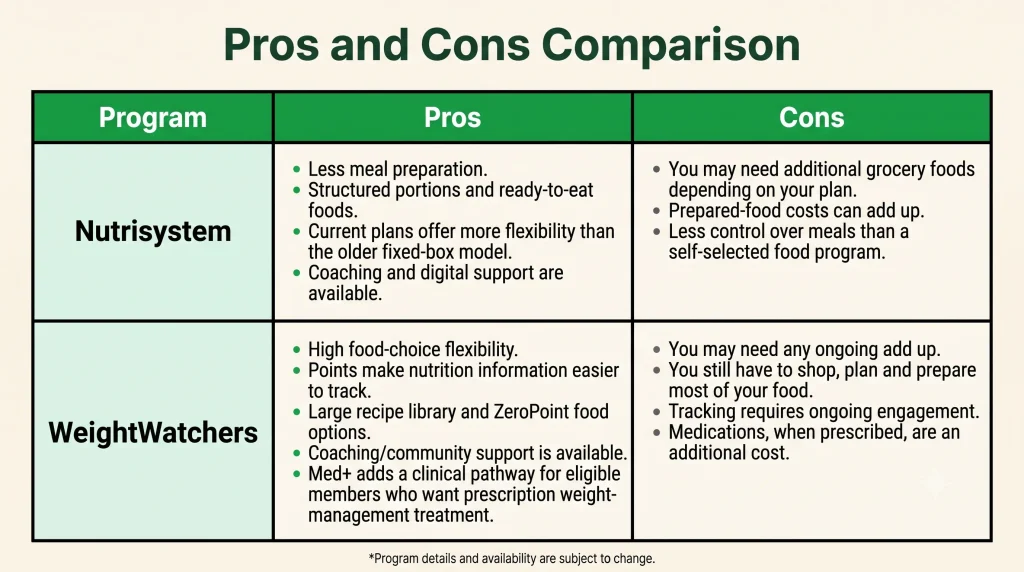
Which Is Better: Nutrisystem or WeightWatchers?
Neither is automatically better.
Nutrisystem is more appropriate for someone who values prepared food and reduced meal-planning effort.
WeightWatchers may be a better fit for someone who wants to eat a wider range of self-selected foods and is comfortable planning and tracking meals.
The right comparison is not simply ‘which diet works better?’ It is ‘which system can I realistically follow and maintain?’
WeightWatchers vs. Jenny Craig
Jenny Craig and WeightWatchers both provide coaching and structured support, but their food models are almost opposite.
Jenny Craig supplies prepared food to reduce meal planning.
WeightWatchers gives you control over the foods you choose and uses Points to guide those choices.
Cost: WeightWatchers vs. Jenny Craig
WeightWatchers Core currently starts at $12/month, Core+ at $22/month and Med+ at $25 for the first month followed by $74/month. Jenny Craig’s current website lists a Jenny Craig Program at $329.99 and Breakfasts & Entrees plans at $169.99, along with other meal configurations. Club Jenny is $12.99/month.
These figures should not be treated as apples-to-apples prices because Jenny Craig prices are primarily tied to food/meal purchases, while WeightWatchers membership prices primarily cover the program, tools and support.
Pros and Cons
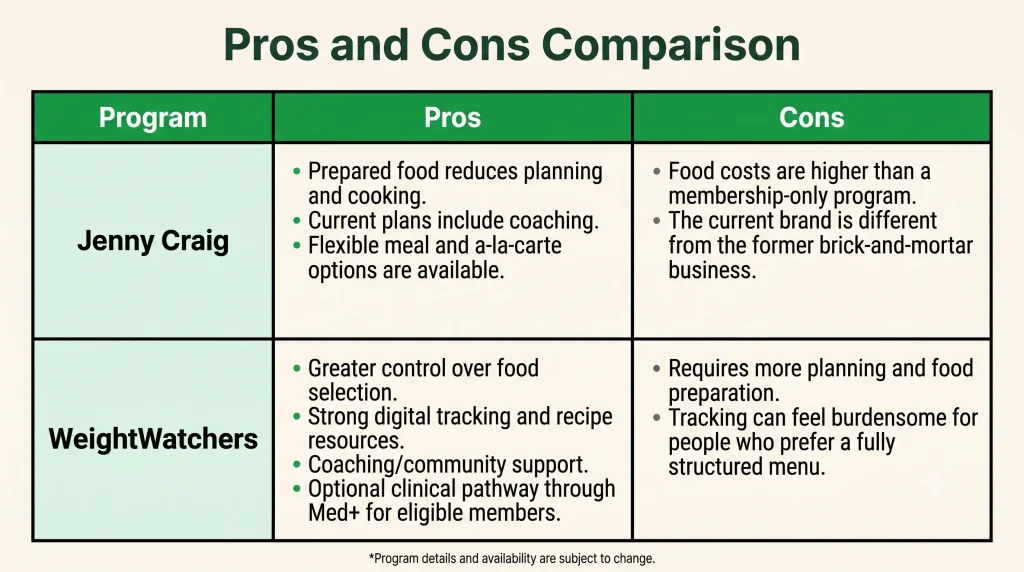
Which Is Better: WeightWatchers or Jenny Craig?
If your priority is minimizing meal preparation, Jenny Craig has the more structured food-delivery model.
If your priority is choosing your own foods and using a tracking system, WeightWatchers provides more flexibility.
Neither approach is inherently better for every person.
Ideal Protein vs. Jenny Craig
Ideal Protein and Jenny Craig both provide coaching and food products, but the underlying structure is different.
Jenny Craig is primarily a prepared-food meal-delivery system.
Ideal Protein is a phased protocol that uses specific food rules, protocol products, whole-food guidance and coaching, followed by Stabilization and Maintenance.
Cost is also structured differently. Jenny Craig publishes plan-specific food prices, while Ideal Protein states that the protocol averages about $17/day in North America for food and supplements; local consultation fees can vary. Ideal Protein+ now offers a separate subscription model with food and coaching.
If you prefer a prepared-food menu with flexible ordering, Jenny Craig may feel simpler.
If you prefer a more structured protocol with a defined transition into maintenance, Ideal Protein is a different type of experience.
Ideal Protein vs. WeightWatchers
WeightWatchers gives members substantial control over their food choices through the Points system and ZeroPoint foods.
Ideal Protein is more prescriptive during active weight loss, with specific food categories and protocol products, followed by Stabilization and Maintenance.
WeightWatchers may be more appealing if you want to eat a broad range of foods and track your choices.
Ideal Protein may appeal to someone who wants a more structured approach and prefers coaching around a defined protocol.
Again, there is no universal winner. The better fit depends on your goals, preferences, health considerations, tolerance for dietary structure and ability to maintain the approach over time.
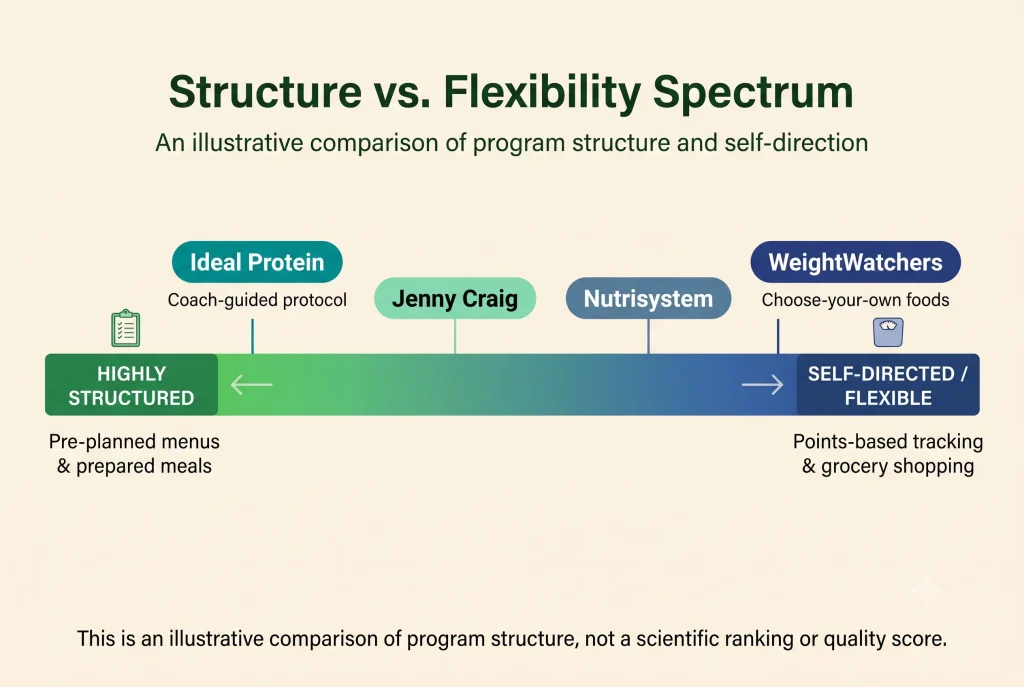
Overall comparison of these 3 diets
Let’s see how Consumer Affairs compares these programs:
Most convenient: Jenny Craig
Jenny Craig’s program comes with weekly 1-on-1 counseling sessions with certified consultants, and a personalized meal and exercise plan. They have convenient pre-packaged meals, which are eaten during the first half of the diet. Some foods are cinnamon rolls and homestyle beef pot roast, which helps you stay on track while keeping you satisfied with your favorite foods on the menu. The second half of the program focuses on transitioning back to home-cooked whole foods.
Most popular: Nutrisystem
Nutrisystem eliminates the guesswork for healthy eating by mailing the “perfect-portioned” meals to your door. Their plan for women includes 4 meals per day, which means eating every two/three hours to promote greater weight loss and maintenance.
Most freedom: Weight Watchers
Goes best for strict dieters, people with gluten-free, vegetarian, or vegan dietary needs. WW promotes and encourages healthy eating through a tracking system. This fit-point system helps you understand what you eat on a daily basis and the value of each food you eat, which in turn educates participants on healthier eating habits without too much restriction.
A dieter’s personal experience with Ideal Protein
Not long ago, I reached a 55-pound weight loss milestone on Ideal Protein’s low carb, adequate-protein diet approach. I previously thought I needed to lose 15 more pounds to put on my “favorite pants”. One day, I decided to try them on, and to my surprise, they FIT perfectly. The reason is that I had been losing only fat, so I’m decreasing in size more quickly than I would have by dropping the same amount of weight on Jenny Craig, WW, or Nutrisystem.
All these diets are nothing new to me. Before finding Ideal Protein, I have followed all the low carb and low-fat diets mentioned above to lose weight, but I must admit, while I gave my best to them, it wasn’t easy. Between constantly thinking about food, and packing my schedule with exercise, I barely had time for anything else.
But unlike others, the Ideal Protein Weight loss protocol does not come with any strenuous exercise regimen.
Note: we are not telling you not to exercise and turn into a couch potato. We are saying that you won’t have to kill yourself with rigorous exercises to lose weight.
What Does the Research Say About These Programs?
Research can help put commercial-program claims into context, but there is an important limitation: many studies evaluated older versions of programs. A study of a 2010s version of a brand does not prove that the 2026 version is identical.
Commercial weight-loss programs: the 2015 systematic review
An updated systematic review published in the Annals of Internal Medicine included 45 studies, 39 of which were randomized controlled trials.
At 12 months, the review found:
- WeightWatchers participants achieved at least 2.6% greater weight loss than control/education groups.
- Jenny Craig participants achieved at least 4.9% greater weight loss than control/education and counseling.
- Nutrisystem participants achieved at least 3.8% greater weight loss than control/education and counseling at 3 months.
The authors also highlighted important limitations: many trials were short, had substantial attrition and lacked blinding. The review therefore supports the idea that some commercial programs can produce meaningful weight loss, but it does not establish that one brand is universally superior.
Direct comparisons do not show a universal winner
A separate systematic review of direct comparisons between commercial weight-loss programs found limited evidence that any one commercial program was superior for weight, waist circumference or blood-pressure outcomes.
This is useful when interpreting ‘best diet’ claims. A program may work well in one trial or for one person without proving that it is the best choice for everyone.
A newer WeightWatchers randomized trial
A 2025 randomized controlled trial included 376 U.S. adults with overweight or obesity and compared a digital WeightWatchers program with standard nutritional guidance.
At six months:
- WeightWatchers participants lost an average of 5.4% of body weight.
- The standard-guidance group lost 1.5%.
- The between-group difference was 3.9 percentage points.
- Participants in the WeightWatchers group were also more likely to reach 3%, 5% and 10% weight-loss milestones.
This was a randomized trial, which strengthens the evidence. However, it was not a head-to-head comparison with Jenny Craig, Nutrisystem or Ideal Protein, and the study was funded by WW International. The results therefore should not be interpreted as proof that WeightWatchers is better than the other programs.
Ideal Protein randomized trial
A randomized, assessor-blinded trial assigned 192 adults with obesity to either an Ideal Protein Phase I intervention or a guideline-based low-calorie, low-fat dietary behavioral intervention.
At three months:
- Mean weight change was -9.6 kg in the Ideal Protein group versus -1.6 kg in the low-fat/low-calorie group.
- The mean between-group difference was -8.1 kg, with a 95% confidence interval of -16.6 to 0.6 kg and p=0.05.
- The Ideal Protein group also had greater reductions in waist and hip circumference, total cholesterol and triglycerides.
The study is important because it is randomized and directly evaluates the Ideal Protein system. But the primary endpoint was only three months, so it should not be used as evidence of long-term superiority or maintenance.
The study was also funded by a grant from Ideal Protein Laboratories to Tulane University, which should be disclosed when the findings are summarized.
What Happens After You Stop a Weight-Loss Program?
Stopping the ‘active’ part of a weight-loss program does not mean that weight management is finished.
Research on lifestyle interventions shows that weight regain can occur after an intervention ends, although many people maintain at least part of their initial weight loss. A systematic review and meta-analysis of 27 trials involving 7,236 participants found that weight regain began to become more apparent around 36 weeks after intervention completion in some participants. The authors concluded that ongoing monitoring and support can be important.
A larger meta-analysis of 249 behavioral weight-management trials involving 59,081 participants found that greater initial weight loss was associated with faster subsequent regain, but the lower weight was still maintained relative to no intervention for at least five years in the available data. Continued access to a program was associated with slower regain.
The practical takeaway is simple: when comparing programs, ask what happens after the initial weight-loss phase.
Jenny Craig
With the current Jenny Craig model, customers can continue using meal-delivery options and Club Jenny rather than reaching a point where the brand’s food access necessarily stops. Coaching is also available with current plans and Club Jenny.
Nutrisystem
Nutrisystem provides ongoing program and a-la-carte options, depending on the plan. Customers should ask how their selected program transitions into maintenance and what ongoing coaching or food access is included.
WeightWatchers
WeightWatchers is designed around ongoing behavior change and membership support rather than a fixed meal-delivery endpoint. Users can continue using Points, tracking, recipes and coaching/support.
Ideal Protein
Ideal Protein explicitly builds transition into the protocol. Its current model includes Weight Loss, Stabilization and Maintenance phases. That makes the transition from active weight loss to long-term maintenance a defined part of the protocol rather than an abrupt stop.
Pros and Cons: Quick Reference
Jenny Craig
Pros
- Prepared meals and home delivery.
- 1-on-1 coaching.
- Current flexible and a-la-carte options.
- Less daily meal planning.
Cons
- Food-based plans can be more expensive than membership-only programs.
- Current model differs substantially from the historic brick-and-mortar program.
- Some plans still require additional food choices outside the delivered meals.
Nutrisystem
Pros
- Prepared meals reduce planning.
- Multiple current plan configurations.
- Coaching and digital tools.
- Flexible/Flex meal options.
Cons
- Additional grocery purchases may be needed.
- Prices vary by plan.
- Packaged foods are not preferred by everyone.
WeightWatchers
Pros
- High food-choice flexibility.
- Points and ZeroPoint foods.
- Digital tracking and recipe resources.
- Coaching/community support.
- Optional clinical pathway through Med+.
Cons
- Requires shopping, preparation and tracking.
- Membership price does not include a full meal-delivery supply.
- Medication costs are separate from Med+ membership.
Ideal Protein
Pros
- Clearly defined phases.
- Structured food framework during active weight loss.
- Personalized coaching.
- Explicit Stabilization and Maintenance phases.
- Current options include clinic and newer online/subscription models.
Cons
- More restrictive during the active weight-loss phase.
- Requires adherence to protocol-specific food choices.
- Product and coaching costs vary by provider/model.
- The evidence base is smaller than the body of research on some longer-established commercial programs.
Frequently Asked Questions
Is Jenny Craig still in business?
Yes. The original U.S. brick-and-mortar operation closed in 2023, but the Jenny Craig brand was relaunched as a direct-to-consumer/e-commerce business. The current model offers home-delivered meals, Club Jenny, a-la-carte food options and coaching.
Does Jenny Craig still have physical locations?
No. The former U.S. brick-and-mortar centers closed in 2023. Current Jenny Craig operations are primarily direct-to-consumer, with home delivery and remote coaching.
Did Nutrisystem buy Jenny Craig?
The Jenny Craig brand was acquired by Wellful in 2023 and relaunched as a direct-to-consumer business. Nutrisystem is also part of the Wellful portfolio. That does not mean the current Jenny Craig program is simply the old Jenny Craig program under a new name; the business model changed significantly after the 2023 closure.
What is the difference between Jenny Craig and Nutrisystem?
Both rely heavily on prepared foods and home delivery, but their current plan structures differ. Jenny Craig offers meal-delivery plans, Club Jenny and a-la-carte food options, along with coaching. Nutrisystem offers structured meal-delivery programs, flexible meal plans and a-la-carte options, with coaching and digital support.
Which is better, Jenny Craig or Nutrisystem?
Neither is universally better. Jenny Craig may suit someone who wants prepared meals with coaching and flexible ordering. Nutrisystem may suit someone who wants structured meal delivery with several current plan configurations. Compare the full food cost, meal coverage, coaching and maintenance support for your specific needs.
Which is better, Nutrisystem or WeightWatchers?
Nutrisystem is more focused on prepared meals, while WeightWatchers gives you more control over the foods you select and uses Points and tracking. The better fit depends on how much cooking, shopping and tracking you want to do.
Which is better, Jenny Craig or WeightWatchers?
Jenny Craig emphasizes prepared meals and delivery. WeightWatchers emphasizes self-selected foods, Points and behavior change. If you want to minimize meal preparation, Jenny Craig may feel easier. If you want maximum control over your food choices, WeightWatchers may be a better fit.
How much does Jenny Craig cost per month?
There is no single monthly Jenny Craig price because current plans vary. At the time of this October 2026 update, Jenny Craig’s website lists examples including a $329.99 Jenny Craig Program and $169.99 Breakfasts & Entrees plans. Club Jenny is listed at $12.99/month. Promotions and plan configurations can change.
How much does Nutrisystem cost per month?
Nutrisystem pricing varies by plan and the amount of food included. Current public 2026 pricing listings show starting prices around $9.99/day, which is roughly $280 for a 28-day period before discounts, while higher-tier plans cost more. Your actual cost may also include groceries needed for flexible meals.
How much does WeightWatchers cost?
Current WeightWatchers membership pricing includes Core starting at $12/month and Core+ starting at $22/month. Med+ starts at $25 for the first month and then $74/month. Prescription medication costs are separate from the Med+ membership.
How much does Ideal Protein cost?
Ideal Protein says the protocol costs about $17/day on average in North America for food and supplements, although consultation fees vary by location. Ideal Protein+ currently lists a newer subscription model at $499/month or $279 every two weeks, including food and coaching. Local clinic pricing can differ.
Are Nutrisystem meals healthy?
Nutrisystem is designed around portion-controlled prepared foods and current plans include options such as high-protein and carb-conscious foods. Whether a particular meal is a good fit depends on its ingredients, nutrition facts and your individual dietary needs. Review the nutrition label and ingredients rather than judging the entire program from its brand name.
Does Jenny Craig work?
Earlier randomized trials found that Jenny Craig participants lost more weight than control/education groups at 12 months. However, much of the peer-reviewed evidence evaluates older versions of the program, and the current Jenny Craig business model changed after 2023. Evidence from an older program should therefore be interpreted as evidence about that intervention, not as a guarantee for today’s program.
What happens after you stop a weight-loss program?
It depends on the program. Jenny Craig and Nutrisystem can continue through ongoing food and support options. WeightWatchers is built around continuing membership-based behavior support. Ideal Protein explicitly includes Stabilization and Maintenance phases. Research also shows that some weight regain after behavioral programs is common, which is why maintenance planning matters.
Can I regain weight after stopping a diet?
Yes, weight regain can occur after a weight-loss intervention. That does not mean everyone regains all of the weight. Research suggests that ongoing support, monitoring and maintenance strategies can help people preserve more of their weight loss.
Is Ideal Protein better than Jenny Craig, Nutrisystem or WeightWatchers?
There is no universal winner. Ideal Protein is more structured than the other programs during active weight loss and includes defined Stabilization and Maintenance phases. Whether that structure is appropriate for you depends on your goals, food preferences, health considerations, budget and willingness to follow a more prescriptive approach.
Which weight-loss program includes prepared meals?
Jenny Craig and Nutrisystem both currently offer prepared meals delivered to the home. WeightWatchers is primarily a self-selected-food and tracking program rather than a traditional full meal-delivery service. Ideal Protein uses protocol-specific products alongside whole-food guidance.
Which program offers one-on-one coaching?
Current Jenny Craig offers 1-on-1 coaching. Nutrisystem’s current program materials also include 1-on-1 coaching. WeightWatchers offers coaching/support, and Med+ adds clinical care for eligible members. Ideal Protein is coach-guided through its protocol.
Can I exercise while following these programs?
Exercise recommendations should be individualized. None of these programs should be interpreted as a reason to avoid physical activity. If you have a medical condition, are taking medication or are starting a substantial weight-loss program, discuss an appropriate exercise plan with your healthcare professional.
Our Bottom Line
Jenny Craig, Nutrisystem, WeightWatchers and Ideal Protein are not four versions of the same diet.
They solve the ‘how do I lose weight?’ problem in different ways:
- Jenny Craig: prepared food + home delivery + coaching + flexible ordering.
- Nutrisystem: structured prepared foods + flexible meal options + digital support/coaching.
- WeightWatchers: Points + self-selected foods + tracking + coaching/community, with an optional clinical medication pathway.
- Ideal Protein: structured protocol + coaching + defined Weight Loss, Stabilization and Maintenance phases.
The right choice depends on the person using it.
Before enrolling, compare five things: what you will actually eat, how much preparation you will need, the complete cost, the support you will receive and what happens after the initial weight-loss phase.
If you are specifically considering Ideal Protein, BioIntelligent Wellness offers a free consultation with an Ideal Protein coach. The goal of the consultation is not to tell you that one program is automatically right for you, but to help you understand the protocol and whether its structure fits your individual goals and circumstances.